The Rotation Trade Goes Granular: Small Caps, Equal-Weight, and Chips to Hyperscalers into Q2 Earnings
The rotation trade is still very much alive beneath the surface of US equities heading into the second-quarter earnings season. The headline index sits range-bound near its highs, which makes it easy to conclude that nothing is happening. Underneath, plenty is happening. Small caps are leading large caps by the widest margin since 2003, the equal-weight S&P 500 is beating the cap-weight, and inside technology the crowd is rolling from semiconductors into the hyperscalers. This is not a clean style shift. It is a rotation that has become granular, cycling within sectors rather than across them.
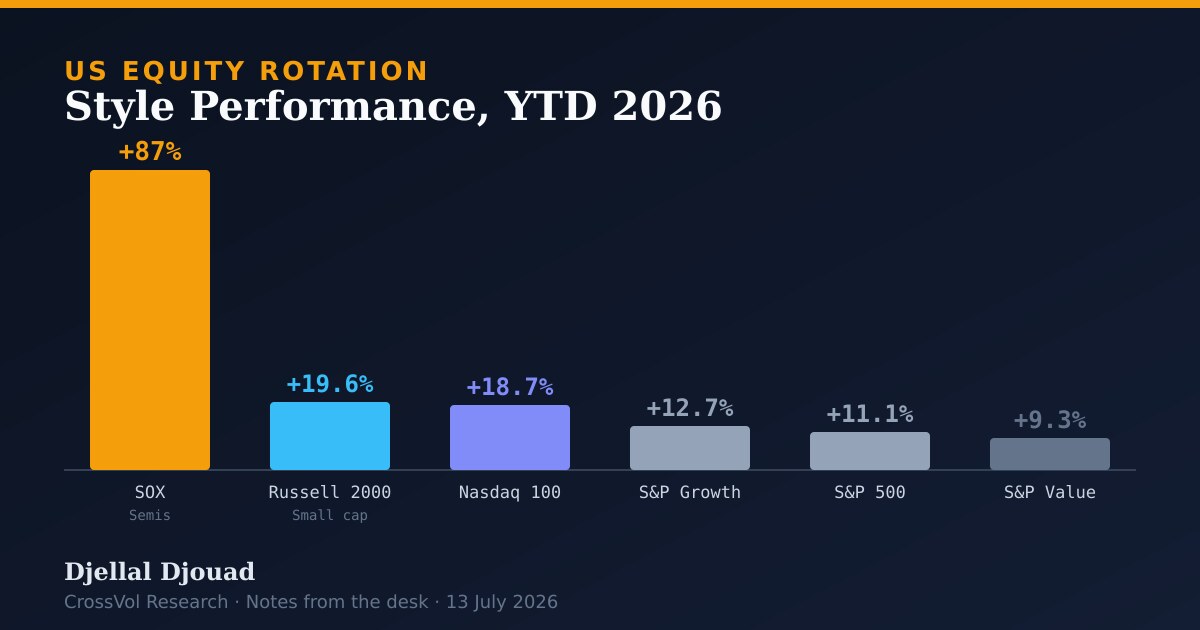
Style and index performance, YTD 2026
| Index | YTD return |
|---|---|
| Philadelphia SOX (Semiconductors) | about +87 percent (as of Jul 9) |
| Russell 2000 (Small Cap) | +19.6 percent |
| Nasdaq 100 | +18.7 percent |
| S&P 500 Growth | +12.7 percent |
| S&P 500 | +11.1 percent |
| S&P 500 Value | +9.3 percent |
for(['NDX Index', 'RTY Index', 'SGX Index', 'SPX Index', 'SVX Index']) get(total_return(calc_interval=YTD))Key rotation dynamics
- Small caps leading large caps. The Russell 2000 has outperformed the S&P 500 by nearly 14 percentage points in the first half of 2026, the largest such gap since 2003, supported by strong earnings momentum and the broader rotation away from mega-cap tech. When the smallest, most rate-sensitive part of the market leads by this much, it is telling you the breadth story is real, not a headline artefact.
- Equal-weight versus cap-weight. The equal-weighted S&P 500 has outperformed the cap-weighted index since mid-May. Morgan Stanley's Mike Wilson notes the median S&P 1500 company is now delivering double-digit EPS growth, the strongest since the post-Covid recovery. That is the single cleanest signal that the rally is broadening on fundamentals rather than on multiple expansion in a handful of names.
- Within tech, chips versus software versus hyperscalers. This is not a simple risk-off move. Semiconductors surged about 5 percent on July 9 and carry long crowding at the 94th percentile, while software has broadly lagged. Morgan Stanley sees momentum fading in semis as investors shift toward the AI hyperscalers, Microsoft, Amazon and Meta. I traced the plumbing of that hyperscaler bid in The AI Debt Trojan, and crowding at the 94th percentile is exactly the kind of positioning that unwinds fast when the marginal buyer steps away.
- Hedge fund repositioning. Goldman Sachs prime brokerage data as of July 10 shows crowding rotating decisively. Investors are rearranging their favourite trades, not exiting them. That distinction matters. Rotation inside a fully invested book behaves very differently from a de-risking.
- Global risk appetite supporting US. HSBC strategists noted as of June 30 that US funds are the primary beneficiary of rising global risk appetite, with weekly equity fund inflows at their highest since March 2021. The bid from abroad is a big part of why the index can churn violently underneath and still hold near its highs.
Earnings season as the next catalyst
The rotation has been churning without a definitive directional break, with the S&P 500 broadly range-bound near its highs for about a month. A stronger earnings anchor is widely seen as the next potential catalyst, the thing that either validates the broadening trade or reasserts mega-cap dominance. Morgan Stanley sees the rally continuing to broaden on earnings resilience in the median stock, with consumer discretionary and transports as its preferred expressions. This is the same breadth question I kept coming back to in Five Signals: the tape can look calm at the index level while the internals are doing all the work.
Bottom line. The rotation is still in play. It has simply become more granular, cycling within sectors, chips to hyperscalers, large cap to small cap, growth to equal-weight, rather than a clean style shift. For a book, that argues for expressing the broadening through the median stock and the equal-weight index rather than chasing the semis that already carry 94th-percentile crowding. Q2 earnings is the anchor. A resilient median EPS print keeps the breadth trade alive. A miss there, and the reflex is straight back into the mega caps.
Sources
Bloomberg terminal news and strategist notes, 29 June to 13 July 2026.
- Small Caps Track Largest S&P 500 Lead Since 2003: Equity Insight. Bloomberg, 29 June 2026.
- Morgan Stanley Strategists See US Rally Broadening on Earnings. Bloomberg, 13 July 2026.
- Morgan Stanley's Wilson Sees Rotation From Chips to Hyperscalers. Bloomberg, 6 July 2026.
- Chipmakers Rally and Software Slumps as Tech Rotation Continues. Bloomberg News, 9 July 2026.
- The Crowd Is Rotating Fast Beneath the Surface: Equity Insight. Bloomberg, 10 July 2026.
- HSBC Strategists See US Funds Benefit From Risk-On Rotation. Bloomberg, 30 June 2026.
- Sector Rotation Can't Stop, Won't Stop. Bloomberg, 2 July 2026.