Oil Market Update, 13 July 2026: Hormuz Escalation, a Bullish Skew, and the Return of the War Trade
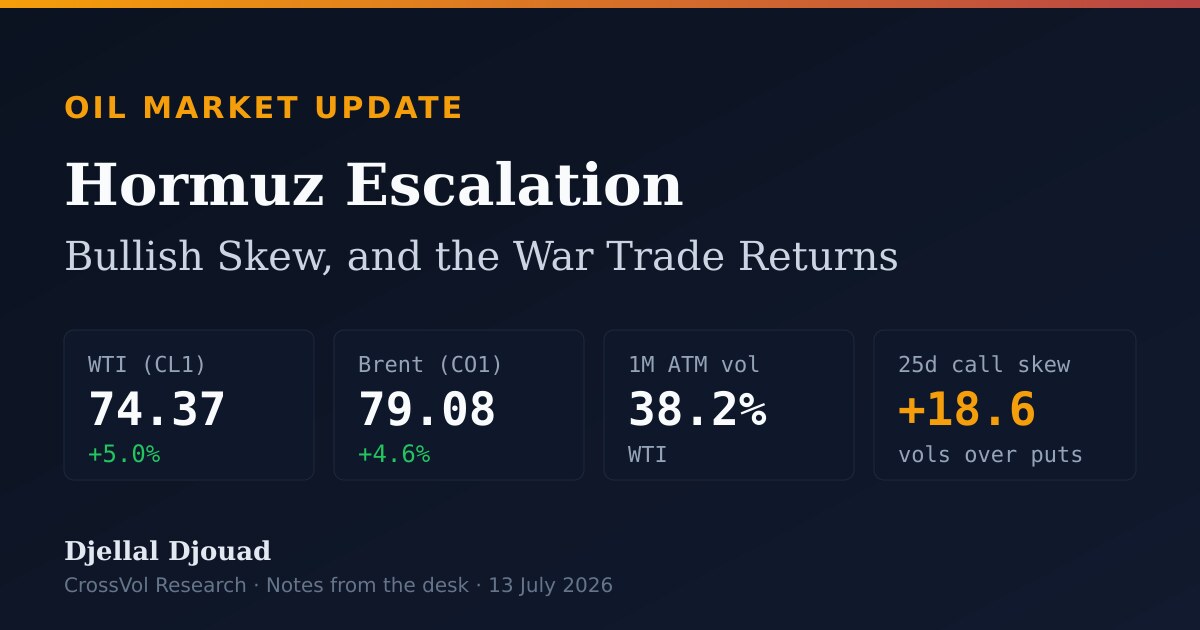
The weekend handed crude another leg higher. WTI is back near 74 dollars and Brent near 79 after a fresh round of US strikes on Iran, and the tape underneath the headline print is what matters. One-month at-the-money vol is in the high thirties, and the 25-delta call skew is trading roughly 18 vols rich to puts on both benchmarks. That is not a hedging flow. That is directional demand for upside. The options market is pricing a hard Strait of Hormuz closure as a live tail risk, and the physical market is quietly confirming the anxiety while one producer, Kuwait, cuts its selling prices into the move.
The dominant driver: Hormuz escalation
The weekend brought a significant escalation in the US-Iran conflict. The United States carried out a fresh wave of strikes overnight Sunday into Monday, targeting Iranian air-defense systems, coastal radar sites, and missile infrastructure, described as aimed at degrading Iran's ability to threaten shipping. Iran declared the Strait of Hormuz closed until further notice. US Central Command maintained the waterway remains open and that US forces are positioned to ensure freedom of navigation.
The ground truth is murky. A maritime advisory group confirmed the southern Hormuz route along the Omani coastline remained physically passable as of Sunday, but all six commodity carriers that transited the strait on Sunday did so with transponders turned off, so-called dark crossings, per preliminary Kpler data. Observable crossings have all but ceased. If this feels familiar, it is because we have watched this exact workaround before. I wrote about the mechanics of it in The Hormuz Stalemate: barrels keep moving, but the market loses its ability to see them, and that opacity is itself a risk premium.
Spot prices
| Contract | Last (USD per bbl) | Session move |
|---|---|---|
| WTI (CL1) | 74.37 | about +5 percent |
| Brent (CO1) | 79.08 | about +4.4 to 4.9 percent |
Brent had already rallied 5.4 percent last week before this morning's additional leg higher. This is the fourth consecutive weekend where a strike headline has repriced the front of the curve on the Monday open.
for(['CL1 Comdty', 'CO1 Comdty']) get(fut_trading_units, px_last)Implied volatility and skew
| Contract | 1M ATM implied vol | 25-delta call over put skew |
|---|---|---|
| WTI (CL1) | 38.2 percent | +18.6 vols (calls over puts) |
| Brent (CO1) | 35.7 percent | +18.0 vols (calls over puts) |
Implied vol is elevated across both benchmarks, consistent with a genuine supply-disruption fear premium rather than a purely speculative move. The skew is what makes this interesting. Twenty-five-delta calls trade roughly 18 vols rich to puts on both WTI and Brent, which tells you the options market is pricing meaningful upside tail risk, a hard Hormuz closure scenario, far more aggressively than downside. In a normal oil market the skew leans the other way, because producers hedge and consumers do not. A call skew of this magnitude is directional demand for upside exposure, not a hedging artefact. When the surface looks like this, gamma is expensive for a reason, and selling it against a live geopolitical catalyst is how desks blow up.
for(['CL1 Comdty', 'CO1 Comdty']) get(implied_volatility, implied_volatility(expiry=1STM, delta=25)-implied_volatility(expiry=1STM, delta=25, put_call=PUT))Positioning and flow signals
- Dark ship crossings. The shift to transponder-off transits is a real-time positioning signal from physical market participants. They are moving barrels but unwilling to advertise it, which reflects acute uncertainty about the legal and military status of the strait.
- China stockpiling. Chinese refiners are reportedly being instructed by Beijing to keep fuel output high, and analysts forecast a return to strategic crude stockpiling later this year as China snaps up prompt Middle East supplies. That adds a demand-side bid beneath spot prices, right when the geopolitical premium is already doing the lifting.
- Kuwait OSP cuts. Kuwait Petroleum cut its August official selling prices sharply. Export crude to Asia moved from a plus 5.25 dollar per barrel premium to a minus 5 dollar per barrel discount to benchmark, a swing of over 10 dollars per barrel. European prices were cut by 6.45 dollars across the board. This is the one bearish tell in the tape. It reflects a producer trying to defend market share against genuine demand fragility, and it sits directly against the geopolitical bid.
- Cross-asset confirmation. The risk-off read is broad. US 2-year yields hit their highest since early 2025, Asian equities are sharply lower with the Kospi down 8 percent and SK Hynix down 15 percent, and the dollar is strengthening against all G10 peers. This is consistent with a genuine macro shock, not just an oil-specific move. I flagged how quickly these correlations snap back on in Five Signals.
- Ukraine wildcard. Ukraine struck Russia's Syzran refinery in the Samara region and tankers in the Sea of Azov over the weekend, adding a secondary supply-disruption vector that the market is barely pricing yet.
Key tension to watch
The market is caught between two forces. On one side is the geopolitical fear premium, visible in the Hormuz closure risk, the elevated vol, and the bullish skew. On the other is the fundamental softness signal, visible in Kuwait slashing official selling prices and in China only now returning to stockpiling after a demand slump. Mohamed El-Erian has warned of a significant intensification that could test the market's assumption the conflict stays contained. Bloomberg's cross-asset strategists note that the pattern of recurring weekend strikes is establishing a floor under crude for the short to medium term. That floor is exactly what the skew is monetising. This is the same convergence-of-faults dynamic I laid out in The Coming Crash, where a single catalyst forces several loosely related risks to reprice at once.
Bottom line. Vol and skew are telling you the options market is pricing a hard upside scenario, a full Hormuz disruption, as a live tail risk rather than a remote one. Physical market behaviour, the dark crossings and the China stockpiling, corroborates genuine supply anxiety. The Kuwait OSP cuts are the one bearish counterpoint, and they suggest producers see demand fragility beneath the geopolitical noise. Long gamma with a call bias is the position the surface is rewarding. The risk to it is a fast, verifiable reopening of the strait, at which point this entire premium unwinds in a session.
Sources
Bloomberg terminal news and market wires, 11 to 13 July 2026. Outlet links point to the relevant desks.
- US and Iran Trade Fresh Strikes, Dispute Whether Hormuz Is Open. Bloomberg News, 13 July 2026.
- Ships Pass Through Hormuz in Secret as US and Iran Trade Strikes. Bloomberg News, 13 July 2026.
- Asian Energy Stocks Gain With Oil After More US-Iran Strikes. Bloomberg, 12 July 2026.
- China's Oil Imports May Be Set to Recover as Stockpiling Returns. Bloomberg News, 13 July 2026.
- China Tells Refiners to Keep Fuel Output High as Iran War Drags. Bloomberg News, 11 July 2026.
- Kuwait Cuts Oil Prices for August Shipments to All Markets. Bloomberg First Word, 13 July 2026.
- Hormuz Conflict Lifts Crude Oil, Dollar and Yields: Macro Squawk. Bloomberg First Word, 13 July 2026.
- Asian Yields Rise With Oil Amid Renewed Iran Tensions. Bloomberg, 13 July 2026.
- Ukraine Says It Hit Russia's Syzran Refinery, Azov Sea Tankers. Bloomberg News, 12 July 2026.
- Oil Rallies 4 percent as Mohamed El-Erian Warns of Significant Intensification in US-Iran War. Benzinga, 13 July 2026.
- Oil Finds a Floor as Strikes Persist From US, Iran: MLIV Chart. Bloomberg First Word, 12 July 2026.