Hormuz, the CPI Print, and Japanese Repatriation: The Risk Confluence of 14 July 2026
Three stories that usually live on separate desks are converging this morning. A naval blockade at the Strait of Hormuz is pushing Brent above 85 dollars. A CPI print at 8:30 Washington time will decide whether the Fed puts a July hike fully in play, and the odds have already moved from under ten per cent to roughly half. And underneath both, a structural shift in Japanese capital is quietly draining the marginal bid for US Treasuries. Individually, each is a headline. Together, they point the same way: higher energy, higher rates, and a rotation out of the crowded growth trade. That is the confluence I am trading.
1. Hormuz is back, and the risk premium is back with it
President Trump reinstated a full naval blockade on Iranian shipping through the Strait of Hormuz, effective 16:00 New York time, with an unprecedented twist: a 20 per cent levy on every other cargo transiting the strait, roughly 30 million dollars per supertanker. CENTCOM ran a five-hour air campaign against Iranian targets, and Tehran answered asymmetrically with drone strikes on US assets in Kuwait and cruise missiles at a vessel in the region. The UAE reported two of its tankers hit in Omani waters. Saudi air defences intercepted Houthi ballistic missiles. This is no longer a bilateral standoff. It is a regional one.
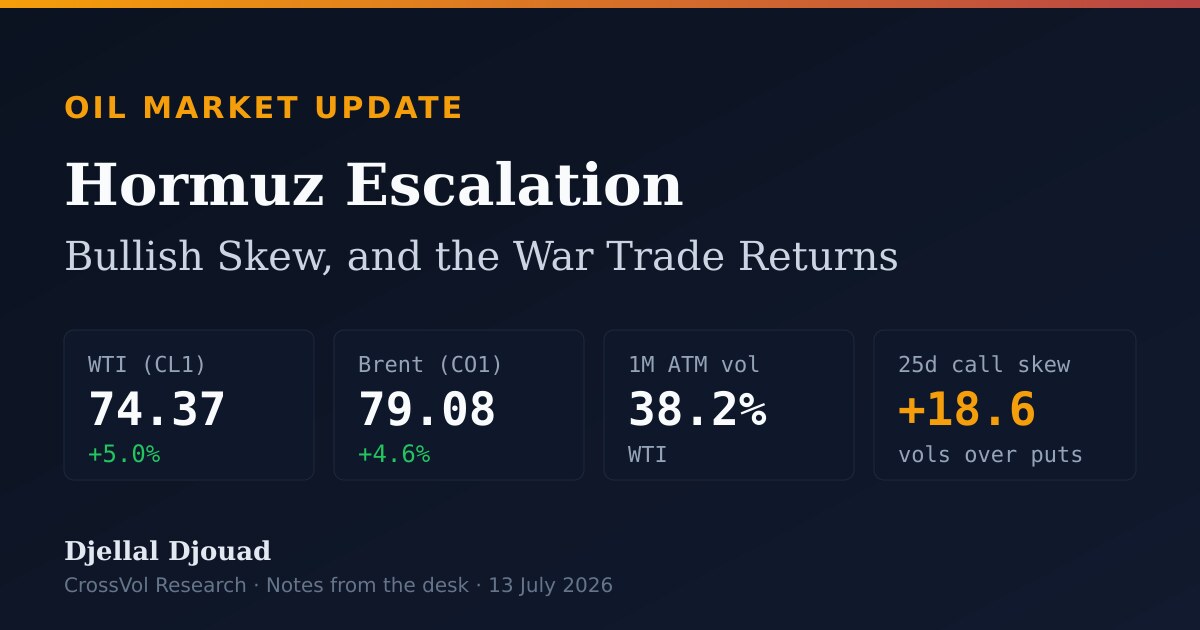
The tape repriced fast. Brent traded up 2.8 per cent at the high and settled near 84.82 dollars, its first move above 85 in a month and close to a 13 per cent gain over two sessions. WTI pushed toward 80. European gas at the TTF hub jumped 3.3 per cent to a three-month high on LNG supply fears. What matters for anyone pricing options is not the spot move but the shape of the curve. The blockade threatens to pull back the 57 million barrels Iran managed to export during the brief lull, and that supply loss is being written straight into the forward premium. Jay Hatfield frames the fan: 80 dollars if nothing else breaks, a sharp drop toward 60 if the strait reopens, a run to 90 or 100 if the conflict widens. I lean toward the fat right tail, because the physical market is already confirming the anxiety. Gulf producers were front-running this: the UAE lifted output to 3.8 million barrels a day in June, up 1.71 million on May, using shuttle tankers running dark.
I laid out the mechanics of that dark-shipping workaround last month in The Hormuz Stalemate, and the near-term options positioning on Sunday in the oil market update. The one-line update: the call skew that was rich then is richer now.
2. Equities: the momentum unwind, not the oil, is doing the damage
Asia traded like a see-saw. The Kospi swung from down 5.3 per cent to up 2.5 and closed off 0.6. Taiwan's Taiex fell 2.5 on its AI exposure. The Topix held up, plus 0.2, on the repatriation story I get to below. The Philadelphia Semiconductor Index dropped 4.8 per cent in the US session, extending Monday's slide. The reflex is to blame oil. It is not oil. As David Savage put it, the semis fall owes far more to a deleveraging of Korean equity positions than to crude. SK Hynix alone travelled from minus 9 to plus 4.5 on the day. This is a leverage unwind cascading through correlated names, and the ADR dollar inflow tied to Hynix even decoupled the won from its own equity market.
The question investors are actually asking is whether the AI capex cycle can generate returns proportional to the capital going into it. That is a valuation question, not an energy question, and it is why the rotation has legs. Barclays has value in a sweet spot, twin-fuelled by improving earnings and a higher-for-longer rate backdrop. Goldman's read on the last two weeks is cleaner still: Dividend Aristocrats, real estate and low-volatility names were the least correlated to the momentum drawdown, with value, Europe and infrastructure next in the decorrelation hierarchy. This is the same rotation I walked through in the Q2 earnings note, now accelerating on a macro catalyst rather than a purely factor one.
3. FX: oil importers on the back foot, the hawks rewarded
The currency map sorts almost perfectly by oil exposure and central-bank posture. The net oil importers weakened: USD/INR up 0.6 to 96.16, USD/THB up 0.5, the Philippine peso near a record low. DBS expects the oil-sensitive Asian currencies, the rupee, rupiah and baht, to stay under pressure through three channels at once: deteriorating trade balances, reserve drawdown, and imported-inflation expectations forcing procyclical tightening. The won bucked it, up 0.6, on the Hynix ADR flow and Bank of Korea hike bets.
At the other end, the hawks got paid. The New Zealand dollar rose 0.8 per cent to 0.5796 after Paul Conway warned that inflation may not slow as fast as the RBNZ assumed. Swaps now price two full hikes into year-end and a third in Q1 2027. Two-year Kiwi yields added 10 basis points to 3.66, the ten-year 8 to 4.69. The Aussie underperformed on the cross, AUD/NZD down 0.6 to a level last seen in March, weighed further by the Middle East risk. And the yen sat at its 40-year floor near 162.33, but with two catalysts building underneath it that the market is underpricing.
4. The hawkish turn is synchronised, and that is the real story
Start with the Fed. The probability of a July hike went from under ten per cent to about fifty in a matter of days. Christopher Waller said a hike "in the near future" has to be on the table if core inflation prints another high number. Columbia Threadneedle's Ed Al-Hussainy called the July meeting "very much alive" and said it will take some luck to drag inflation back toward two per cent. The front end moved with it: two-year yields above 4.25, the ten-year at 4.62, both up double digits in basis points since the start of July. BMO's Ian Lyngen makes the point that even a soft CPI may not close the door, because Warsh could surprise with a hike that is not fully priced.
The RBNZ's dovish turn has fully reversed. The Bank of Japan is the outlier that matters most. Its 20-year auction drew a 4.52 times bid-to-cover, the strongest since April, and the yield fell 4.5 basis points to 3.7 while the 30-year sits near 4, close to multi-decade highs. Satsuki Katayama's message on yen assets was blunt: "We will do it at some point." When the Fed, the RBNZ and the BoJ all lean the same way at once, the cross-asset correlation regime that everyone's risk model assumes starts to break. That is the part the single-asset desks are missing.
5. The bond story hiding inside the FX story: Japanese repatriation
This is the piece I would not want to be short. Japanese life insurers are among the largest foreign holders of US Treasuries, and they hold to maturity. As bonds roll off, the proceeds are increasingly being recycled into JGBs rather than reinvested abroad. Three forces push the same way. The cost of hedging the currency erodes the Treasury yield on a hedged basis below what a JGB now offers outright. The J-ICS regulatory regime makes USD/JPY volatility more expensive in capital terms, discouraging fresh unhedged positions. And two policy levers are opening the domestic bid: the potential inclusion of JGBs in the tax-free NISA accounts, and a GPIF portfolio review that Societe Generale estimates could reallocate 76 billion dollars into JGBs. GPIF already sits at 26.91 per cent domestic bonds against a 25 target, so it can add without formally changing the allocation.
The magnitude is what makes it a trade rather than a talking point. Stedman's 2025 vector error correction model at the Kansas City Fed puts the elasticity at 37 basis points of lasting upward pressure on the US ten-year for every 100 billion dollars of Japanese holdings withdrawn. Layer that on a market already fighting an oil-driven inflation impulse and a Fed that may hike into it, and the term premium has a clear direction. US thirties are near 4.80, up 12 basis points on the month, and the marginal price-insensitive buyer is quietly stepping back.
6. The week ahead, and how I am positioned
The calendar is the densest of the year. The June CPI at 8:30 Washington time is the hinge: Bloomberg consensus is 3.8 per cent headline against 4.2 prior, and 2.8 core. It would be the first cooling since January, but the market is right to distrust the durability while crude is climbing, because the energy pass-through into core is a second-round problem that a single soft print does not resolve. Warsh testifies Tuesday and Wednesday on the semi-annual report, and his well-known aversion to forward guidance means even a friendly CPI will not let the market fully unwind hike risk. Then the banks: JPMorgan, Bank of America, Citi, Goldman and Morgan Stanley report, with trading revenue expected near 39 billion dollars in aggregate, the cleanest read we get on institutional risk appetite in a volatile tape, alongside the net-interest-margin squeeze from the curve.
So how do I sit? Long the oil right tail, because the options market is pricing a hard Hormuz closure as a live risk and I would rather own that convexity than be short it into a widening conflict. Constructive on value over momentum, with a bias to the Dividend Aristocrat and low-volatility complex that Goldman flags as the genuine decorrelators, not just "cheap" names. Cautious on the long end of the Treasury curve, where the oil impulse, a possibly hawkish Fed and the Japanese repatriation bid all push yields one way. And respectful of the yen's asymmetry down here: at a 40-year low with the NISA and GPIF catalysts building, the risk-reward on being short yen is no longer attractive. The trade this morning is not any one of these stories. It is that they rhyme.
Flow and volatility commentary in English runs through CrossVol.