The Vehicle Beside the Balance Sheet: Broadcom, Hyperscaler CDS, and the 60 Billion Dollar Question
Broadcom credit protection widened this week, and the tape read it as a warning. It is not one, at least not the kind the reflex assumes. The widening is not the market pricing a weaker Broadcom. It is the market pricing something new that Broadcom is building next to itself, off the balance sheet, at a scale that could one day dwarf the company's own debt. The reported balance sheet is genuinely strong. The contingent one is the story.
Here is what actually happened. Broadcom is reported to be raising more than 60 billion dollars of debt for an AI chip financing vehicle, a structure that reportedly includes a roughly 30 billion dollar junior tranche, with Broadcom guaranteeing a portion of the senior secured tranche. The bond market did not treat that as a distress event. Broadcom bond trading volume surged to more than five times its daily average on 21 August, and clients were net buyers of 25.9 million dollars. That is the footprint of repricing, not of a selloff. When Bloomberg TV flagged "US Chip CDS Worsens" the same day, it was labelling a specific mechanical fact, not a credit crisis. The spread moved because the structure changed, and the structure is worth understanding line by line.
The vehicle beside the balance sheet
Strip the noise and the design is old. This is project finance wearing an AI logo. A special purpose vehicle, legally separate from Broadcom, is set up to buy and own the compute, the XPUs and TPUs, and to lease that hardware to AI labs under long-term agreements. The lead tenant is reportedly Anthropic, ahead of its anticipated IPO, and the point of the structure is precisely that the labs do not carry the assets on their own books. The SPV owns the chips, leases them, and services its debt out of the lease cash flows. Broadcom's role is three things at once: the chip supplier, the sponsor of the vehicle, and, the part that matters for credit, a partial guarantor.
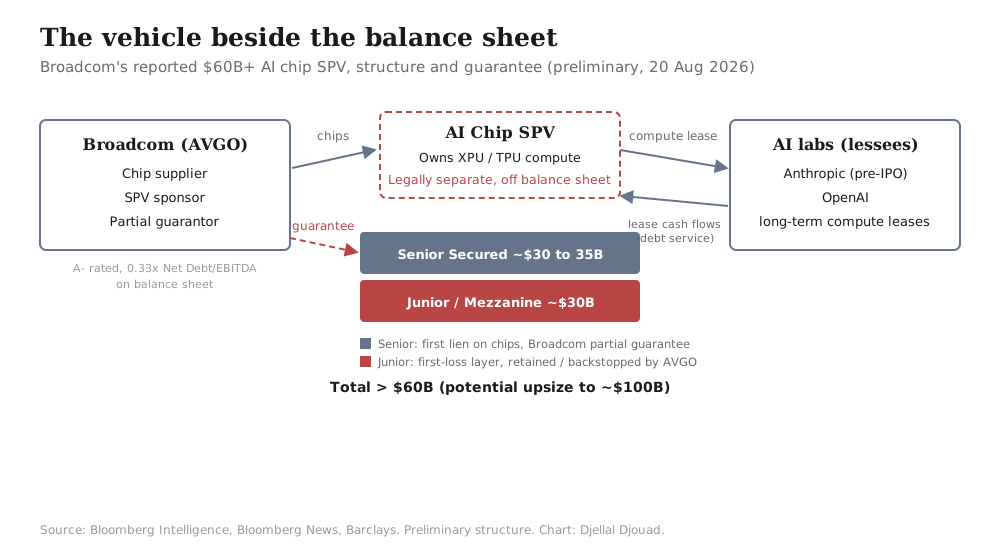
The capital stack is where the risk lives. The senior secured tranche, reportedly 30 to 35 billion dollars, holds the first lien on the chips and carries Broadcom's partial guarantee. Below it sits the junior or mezzanine tranche, around 30 billion dollars, and that is the first-loss layer. It absorbs chip value depreciation and lease payment shortfalls before a senior lender is ever touched. Broadcom is reported to retain or backstop that junior piece. Read that twice. The company is potentially exposed both to the first dollar of loss through the junior tranche it keeps, and to a later call on the guarantee it wrote over the senior tranche. This is exactly the off-statement fragility I traced through the private credit and AI capex chapters of The Coming Shadow Banking Crash, and its blog companion on the four convergent faults. The fault does not show up in the leverage ratio. It shows up in the guarantee.
A strong balance sheet, and a contingent one built in parallel
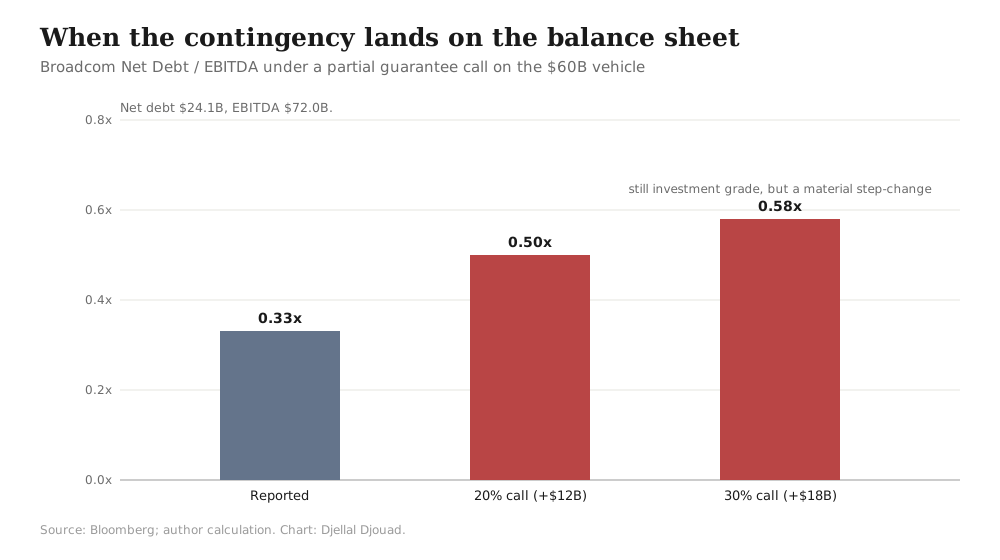
On its own numbers, Broadcom does not screen as a credit under stress, and it is important to say so plainly. S&P rates it A minus with no watch. On a reported FY2026 basis it carries about 63.4 billion dollars of debt against 39.3 billion of cash, roughly 24.1 billion of net debt, 72 billion of EBITDA and about 50.5 billion of free cash flow. That is net debt to EBITDA near 0.33 times. For an A rated technology issuer, that is not just investment grade, it is conservative. Anyone reading the CDS move as core deterioration is reading the wrong line.
The risk is the contingent balance sheet, and it runs through four channels for the existing bondholders, all of whom hold senior unsecured paper. First, a direct guarantee call. If AI chip lease revenues fall short, because demand softens, chips obsolesce, or Anthropic itself has a credit event, the guarantee can be called and an off-balance-sheet contingency becomes a hard liability. Even a partial call of 20 to 30 percent on the initial 60 billion adds 12 to 18 billion dollars to reported net debt, moving the leverage ratio from 0.33 times toward 0.5 to 0.6 times. Still investment grade, but a genuine step-change.
The second channel is the junior tranche itself. Depreciation curves on GPUs and XPUs are steep and uncertain, and a 30 to 40 percent value decline on 30 billion dollars of compute is a 9 to 12 billion dollar loss absorbed in the first-loss layer, before the senior lenders and therefore before the guarantee. The third is structural subordination. Every existing Broadcom bond is senior unsecured at the corporate level. If the SPV is a subsidiary and its debt is secured, that secured debt is structurally senior to the corporate unsecured bonds, and the guarantee obligations can rank ahead of or alongside them in a stress. The holders of the long bonds move down the queue without anyone issuing a press release. The fourth is scale creep, and it is the one that turns a single deal into a market.
The curve is already pricing it
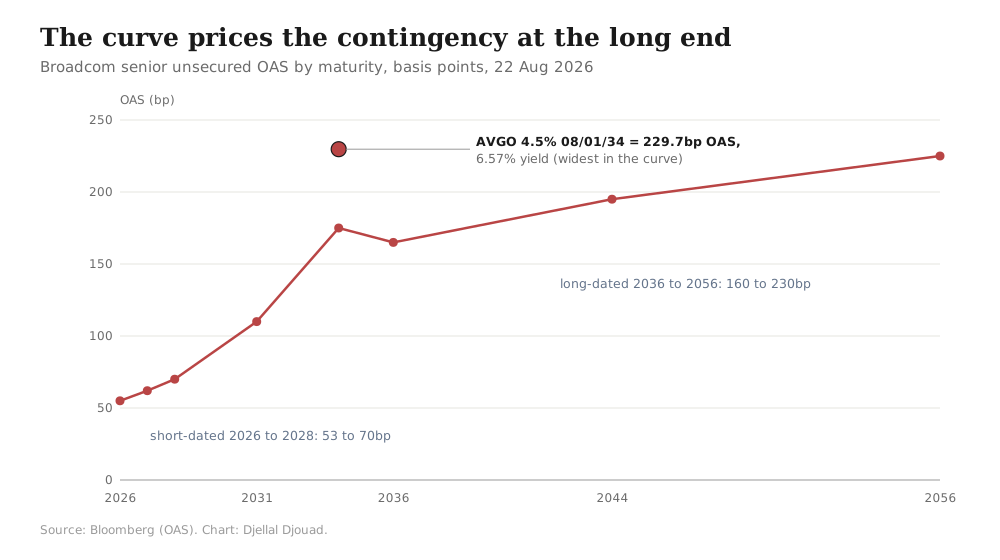
You do not have to take the argument on faith, because the bond curve is voting. Broadcom's short-dated paper, the 2026 to 2028 maturities, trades around 53 to 70 basis points over, which is unremarkable for an A minus name. The long end is a different picture. The 2036 to 2056 bonds trade at 160 to 230 basis points, and the standout is the Broadcom 4.5 percent of August 2034, which sits at 229.7 basis points and a 6.57 percent yield, the widest bond in the curve by a clear margin. A curve that steep is not pricing today's operating credit. It is pricing the probability that the contingent liability story gets worse before it resolves, and it is putting that probability where a guarantee written today would land, out in the long maturities.
Sixty billion is the first iteration, not the ceiling
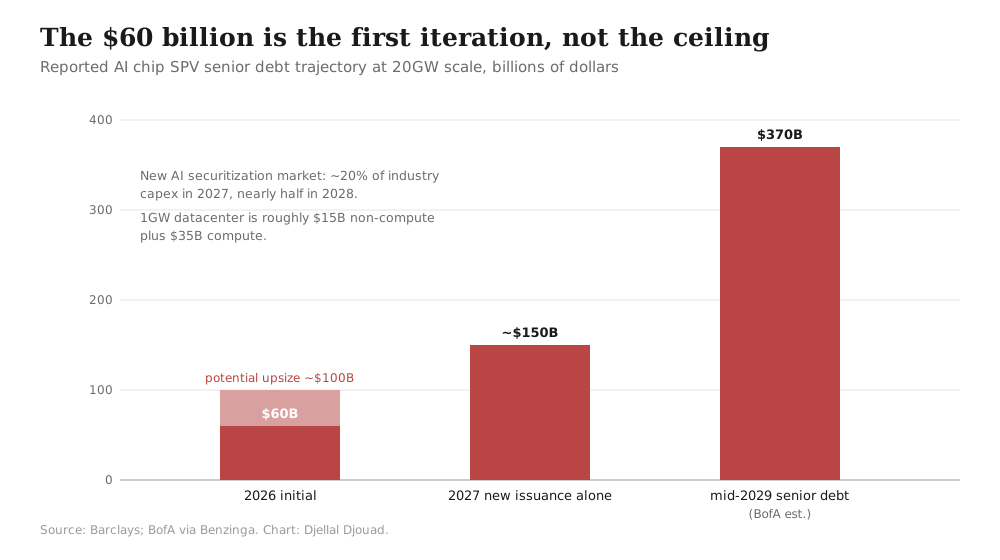
The initial vehicle is not the point. Broadcom has said it intends to finance 20 gigawatts of XPU compute through a new securitization market for AI infrastructure by 2028. At that scale a BofA analyst estimates the vehicle could reach 370 billion dollars of senior debt by mid 2029, including roughly 150 billion of new issuance in 2027 alone. The cost structure explains the gravity: a one gigawatt datacenter runs about 15 billion for the building and non-compute assets and roughly 35 billion for the compute itself, so the compute SPV is the dominant financing need as this scales. Barclays reckons this new AI securitization market could reach 20 percent of industry capex in 2027 and nearly half by 2028.
There is a regulatory door holding this open. The SEC has loosened post-crisis rules for AI datacenter owners issuing asset-backed securities, exempting them from certain disclosure and risk-retention requirements that were put in place after 2008. That accommodation cuts the cost and friction of issuance, and it also cuts the transparency an investor has into the quality of the collateral underneath. Cheaper to build, harder to see into. That combination, a booming off-balance-sheet financing market with reduced disclosure, is the precise setup the sell side is late to, which is the argument of The China AI Disruption Thesis, where the CDS divergence between the hyperscalers and the vendors financing them is one of the four under-priced vectors.
The technical backdrop is deteriorating faster than the fundamentals
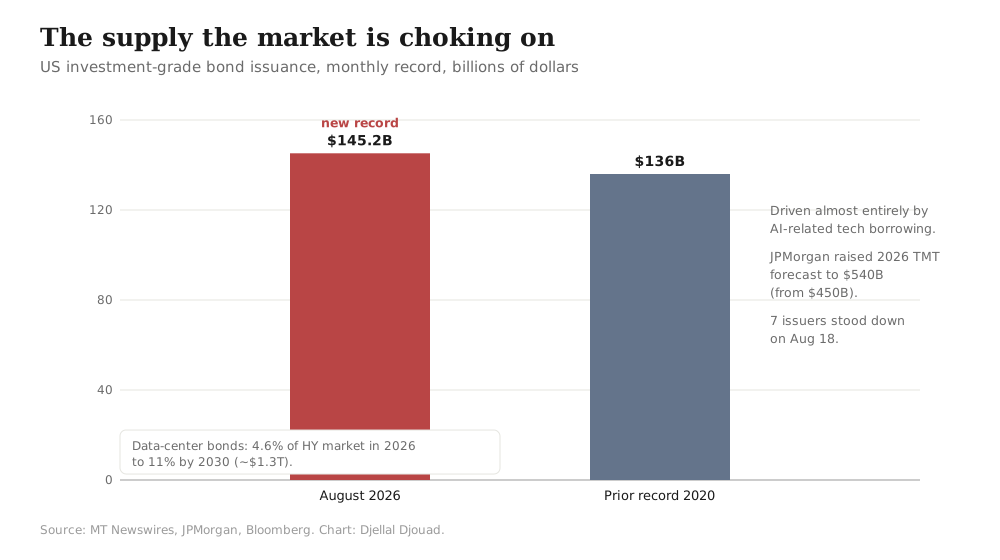
Zoom out from Broadcom and the credit tape is not comfortable. US investment grade issuance hit a record 145.2 billion dollars in August, past the prior monthly record of 136 billion set in 2020, and it was driven almost entirely by AI-related tech borrowing. JPMorgan raised its 2026 technology, media and telecom bond issuance forecast to 540 billion from 450 billion, citing hyperscaler appetite with no sign of abating. On 18 August at least seven issuers stood down from planned IG deals into widening spreads and weak new-issue performance, with concessions reaching about 7 basis points on deals only 2.6 times covered. That is indigestion in the primary market.
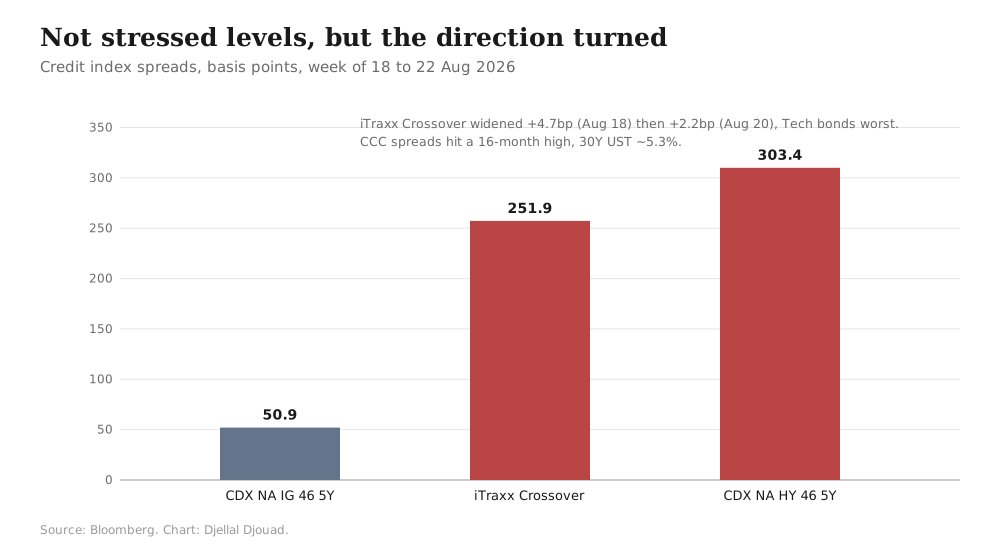
High yield has felt it more acutely. CCC spreads hit a 16-month high on 19 August as the 30-year Treasury yield reached about 5.3 percent, its highest since 2007, and the day produced the biggest one-day high yield loss since 23 July with primary activity near a halt. Loan investors pushed back for the first time in years in late July and early August, and at least four borrowers, including CoreWeave and Proofpoint, had to sweeten terms to get deals done. BNP Paribas strategists flagged the knock-on effect: Big Tech's borrowing spree is lifting CDS costs even for companies with no AI links, as competition for cash intensifies at the top of the IG market. The one steadying reading is that the Bloomberg US Financial Conditions Index is still positive at 1.36, up from 1.13 four weeks earlier, so systemic stress is not registering at the index level. Not yet.
The phantom balance sheet
The Broadcom vehicle does not exist in isolation, and that is the part that should hold your attention. Nvidia and Broadcom are reportedly backstopping more than a trillion dollars of new compute financing, a structure that lets AI labs build infrastructure outside the hyperscaler walls while the contingent liability migrates onto the chip vendors' balance sheets. Bond traders have already flagged roughly 70 billion dollars of what they call phantom liabilities across major AI companies, obligations that do not appear on balance sheets but could materialize at the worst possible moment, which is precisely when credit markets are already under stress. Around the edges the ecosystem is filling in: Blackstone reportedly pitched at least 36 billion dollars of debt to finance Anthropic's use of Google chips in an earlier proposal, and a 16 billion dollar project-finance package for the Anthropic-tied Nexus data centers in Texas is being assembled, with Eagle Point Credit Management providing a 1.3 billion dollar private credit tranche. Barclays projects data-center bonds more than doubling their high yield market share from 4.6 percent in 2026 to 11 percent by 2030, which requires about 1.3 trillion dollars of financing, a structural supply overhang the credit market has to digest for years. This is the same machine I described in the AI debt Trojan inside the IG index and the AI infrastructure financing loop, now visibly scaling.
Is this a serious credit stress?
The honest answer is not yet, and the more useful answer is that the architecture of a future stress is being built in real time. On Broadcom specifically, the CDS widening reflects contingent liability from the vehicle, not core deterioration, and at 0.33 times and A minus the standalone credit is robust. The real question is whether the off-balance-sheet guarantee ever becomes a balance sheet event. Sector-wide, the combination of record IG supply, a 30-year yield above 5.3 percent, primary indigestion and CCC spreads at 16-month highs is a deteriorating technical backdrop, not a crisis, but the margin for error is shrinking quickly.
The tail sits on the calendar. Nvidia reports next Tuesday, and a disappointment on data-center demand would call into question the entire AI capex cycle that underpins something like 1.5 trillion dollars of hyperscaler debt issuance since 2023, against a potential funding gap above 200 billion in 2027 as capex outruns operating cash flow. That is the catalyst that would convert a technical widening into a fundamental repricing. A bond veteran managing 28 billion dollars summed up the mood on 20 August: corporate debt has become so expensive, and the margin for error so small, that caution is warranted even without a visible storm over the economy. When the people who buy credit for a living say do not get too greedy, the desk listens.
The desk read
Broadcom's reported balance sheet is strong, and that is not the exposure. The exposure is the contingent balance sheet being built beside it, off-statement, at a scale that could dwarf the corporate debt stack, wrapped in guarantees whose call is nobody's base case until it is everybody's. The curve already carries it in the long bonds at 160 to 230 basis points. The supply already strains the market at a record 145 billion a month. The tail already has a date on it. The ratings agencies have not moved, but the direction of scrutiny is one way. I laid out the full version of this failure mode, the moment an off-balance-sheet contingency becomes a hard liability inside a crowded, opaque financing market, in The Coming Shadow Banking Crash, and the hyperscaler-versus-vendor CDS divergence it produces in The China AI Disruption Thesis. This week was the market beginning to price the first chapter of it. Watch Nvidia, watch the long end, and watch whether the guarantee stays a footnote.
Further reading from the desk: The Coming Shadow Banking Crash: Inside the $3 Trillion Ticking Bomb · The China AI Disruption Thesis: Why The Sell-Side Is Six Months Late On AI Infrastructure · Same Symptoms, Different Disease: why 2026 is not a rerun of 2022.
Note on the structure: the financing vehicle was reportedly still being finalized as of 20 August 2026. All structural details above are based on disclosed and reported information and should be treated as preliminary.
Sources
- "Broadcom Seeks More Than 60 Billion in Latest AI Debt Deal", Bloomberg News, 20 August 2026.
- "Broadcom's Debt Financing Can Aid Anthropic TPU Ramp-Up", Bloomberg Intelligence, 20 August 2026.
- "Broadcom AI Chip Funding Plan Raises Revenue Upside, Risk", Bloomberg Intelligence, 20 August 2026.
- "Broadcom Bond Trading Jumps to More Than Five Times Average", Bloomberg News, 21 August 2026.
- "Chart on TV: US Chip CDS Worsens", Bloomberg News, 21 August 2026.
- "Broadcom Plunges 5% as Its AI Boom Faces a 370 Billion Financing Question", Benzinga, 14 August 2026.
- "Marvell Gains on Alphabet Agreement, Broadcom Falls: Street Wrap", Bloomberg First Word, 19 August 2026.
- "US Internet and Semiconductors: Unpacking AI Infrastructure, Backstop 101", Bloomberg Intelligence, 20 August 2026.
- "Itraxx Crossover Index Spread Widens; Tech Bonds Worst", Bloomberg News, 18 August 2026.
- "Itraxx Crossover Index Spread Widens; Communications Bonds Worst", Bloomberg News, 20 August 2026.
- "US High-Grade Bond Sales Set August Record as AI Spending Fuels Borrowing", MT Newswires, 17 August 2026.
- "JPMorgan Boosts Tech Bond Sales Outlook as AI Debt Binge Expands", Bloomberg News, 7 August 2026.
- "Alphabet Sells Long Aussie Bond With Record Yield Near 7%", Bloomberg News, 19 August 2026.
- "IG Analysis: Majority of Borrowers Stand Down Amid Weaker Tone", Bloomberg News, 18 August 2026.
- "Tech Drives Up Credit Risk for Safe Firms With No AI Links", Bloomberg News, 13 August 2026.
- "US HY Open: CCC Spreads Hit 16-Month High as Issuance Stalls", Bloomberg News, 19 August 2026.
- "Loan Investors Are Pushing Back as Fear Rises: Credit Weekly", Bloomberg News, 1 August 2026.
- "Market Stress in US Eases: Bloomberg Financial Conditions", Bloomberg News, 17 August 2026.
- "AI Lending Rules Loosened Despite Bubble Fears", The Telegraph, 11 August 2026.
- "Bond Traders Fear 70 Billion Shadow AI Backstops: Credit Weekly", Bloomberg News, 15 August 2026.
- "Blackstone Has Pitched Mega Debt Package for Anthropic Chip Deal", Bloomberg News, 4 August 2026.
- "Anthropic-Tied Data Center Inks 1.3 Billion Private Credit Loan", Bloomberg News, 19 August 2026.
- "Data-Center Bonds to Top 10% of HY Market by 2030, Barclays Says", Bloomberg News, 7 August 2026.
- "Hyperscaler Debt Risks Europe's Allure, Morgan Stanley IM Says", Bloomberg News, 5 August 2026.
- "Don't Get Too Greedy, Says Bond Veteran as Credit Gets Pricey", Bloomberg News, 20 August 2026.