Sixteen tankers clustered off the coast of Oman this past weekend with their transponders dark. A month ago, that stretch of water was empty. Two million barrels a day are now leaking out of the Persian Gulf, against a normal of roughly seventeen to eighteen. Oil is down close to thirty per cent from the early peak of the war. The tape says the crisis has been absorbed. From where I sit on the desk, this is not a resolution. It is the workaround of a stalemate that neither side can publicly fold on, and the question that ultimately decides it has not been asked out loud.
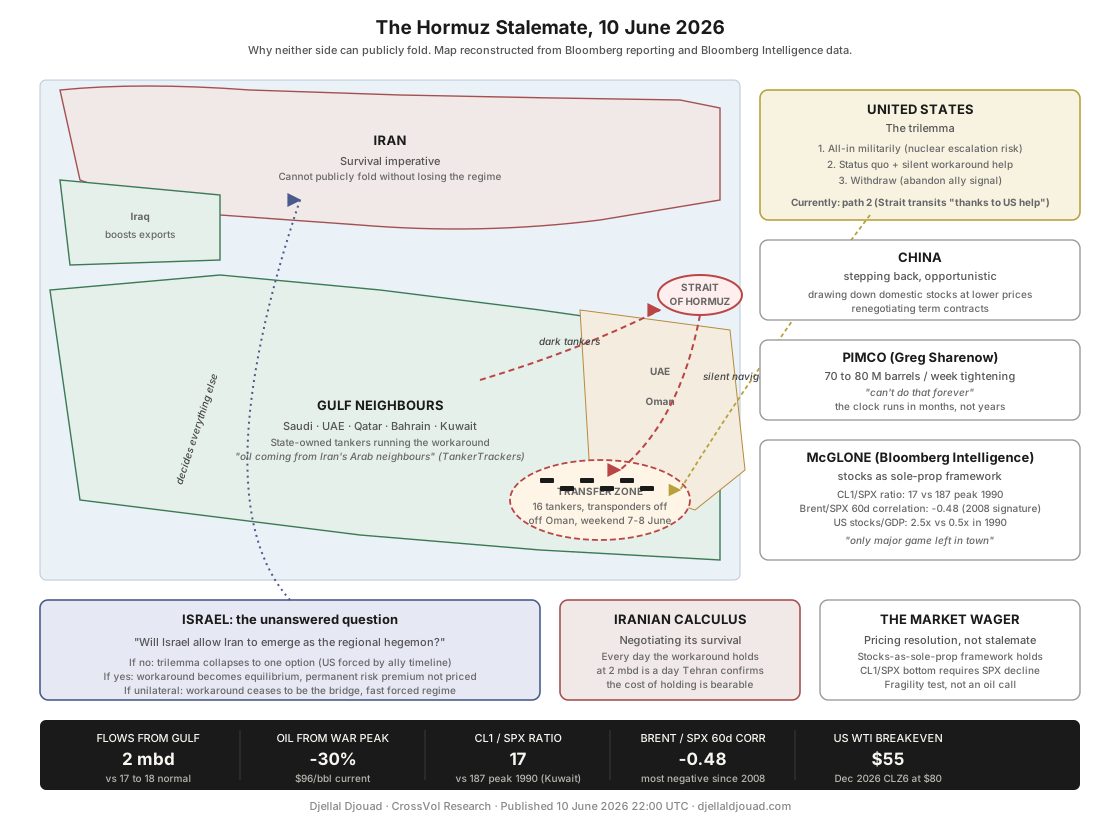
1. The scene, 10 June 2026
At 18:59 GMT today, Bloomberg published a report by Weilun Soon, Salma El Wardany, Prejula Prem and Alex Longley titled Oil Tankers Go Dark to Sneak More Barrels Through Hormuz.1 The piece describes sixteen tankers clustering off Oman over the weekend to transfer millions of barrels of oil that had been stranded inside the Persian Gulf. A month ago, that exact area was empty. Some of the ships crossed under the cover of darkness, with their lights switched off and crews ordered to stay off the radio.2
Larry Johnson, head of freight at Mercuria Energy Group, told Bloomberg that the vessels making it through are "mainly or exclusively government-owned ships", with "channels of communication and means of securing safe passage somehow, some way."3 TankerTrackers.com, working from satellite images, identified twelve ships carrying non-Iranian Middle Eastern barrels conducting transfers outside of Hormuz on the single day of 6 June.4 The transfers off Oman were independently identified by satellite imagery from the European Union's Copernicus browser.5
Rapidan Energy Group puts current flows out of the Gulf at about two million barrels a day. Normal is closer to seventeen or eighteen. President Trump, on Wednesday 5 June, said "people thought it was going to be a lot worse. Today I looked at $96 a barrel, people thought that was going to be $300 a barrel."6
The price action seems to confirm him. Crude is down roughly thirty per cent from the war peak. The Asian LNG basis, similarly, is up but nowhere near the level that the largest Greek shipowner, John Angelicoussis, said he had personally expected.7 The headline read on the market is that the system absorbed the shock.
2. This is a stalemate, not a crisis
My read of the tape is the opposite. The Strait of Hormuz is not unblocked. It is being smuggled around, by a small fleet of government-controlled vessels operating outside the normal commercial perimeter, with the United States quietly helping ships navigate through.8 Two million barrels a day is roughly twelve per cent of the normal flow. Greg Sharenow at Pimco quantified the underlying tightening earlier this month at seventy to eighty million barrels a week, which works out to about three hundred and twenty million a month. He added the line that I keep coming back to: "can't do that forever."9
Crises resolve. A central bank steps in. A line of credit gets opened. A side concedes and the dispute clears at a new price. Stalemates do not resolve. They drag. The Strait of Hormuz today is closer to the second category than to the first, and the reason is that neither of the two principals can fold publicly without losing the thing they actually went into this for.
3. The Iranian calculus
The Islamic Republic is not negotiating over a tariff or a regulatory perimeter. It is negotiating, in its own reading, over its survival. A regime that publicly concedes on the Strait, after having raised the cost of holding the Strait open for the rest of the world, does not survive the concession internally. Its own constituencies, its own armed forces, its own clerical apex, would read the fold as terminal.
From this it follows that Iran has no incentive to settle in the short window. Every day the workaround holds at two million barrels, every day the West does not move from posturing to all-in intervention, is a day that confirms, in Tehran, that the cost of holding is bearable. Trump's framing of $96 versus an expected $300 is, ironically, the cleanest validation of the Iranian position. Tehran reads it as: they thought we would break the market, we did not, and we are still here.
The 1979 lesson, often forgotten in trading desks that focus on headlines, is that Iran existed before sanctions and will exist after them. Its economy is degraded. It is not collapsing in a way that forces a political fold. The clock that matters in Tehran is measured in years, not in weeks of futures rolls.
4. The American trilemma
Washington faces a harder problem than Tehran, and the asymmetry is what locks the stalemate in place. The United States has three options, and each of them carries a cost that policymakers have not been willing to absorb.
All in, militarily. A direct, sustained strike on Iranian assets sufficient to remove the regime's ability to threaten the Strait. The costs are open-ended: escalation toward a nuclear posture by an Iranian state convinced that survival requires breakout, indirect retaliation across the region, and a positioning crisis with China and Russia that no current US administration has shown an appetite for.
Status quo, with the workaround. The current path. Quietly help Gulf producers get barrels out through dark-tanker transfers off Oman. Use US shale's structural cost advantage, with a December 2026 WTI breakeven near fifty-five dollars,10 to mask the strategic cost behind a market price that does not look broken. The risk is the Pimco line: tightening seventy to eighty million barrels a week is not a regime you can run forever. Inventories deplete. The arithmetic catches up.
Withdrawal. Step back, let the Strait sort itself out, let Israel manage its own perimeter. The cost is the public abandonment of an ally and the geopolitical signal that flows from it. No American administration that intends to be re-elected will publicly absorb that cost.
The trilemma is the reason the workaround persists. None of the three options is acceptable enough to push for, and the workaround is cheap enough, for now, to be the path of least resistance. The structural problem is that the workaround is the bridge, not the destination.
5. The Gulf workaround, in detail
The mechanism worth describing precisely, because the loose reporting blurs it. Middle East producers, principally Iran's Arab neighbours, are using vessels they control, mainly state-owned, to ferry barrels outside the Strait of Hormuz. Once clear of the Strait, the cargoes are transferred ship-to-ship onto tankers willing to lift them, often outside Iranian visibility because transponders are dark and crews are silent on the radio.11
TankerTrackers attributes the cargoes plainly: "This is oil coming from Iran's Arab neighbours."4 That sentence carries the part of the story that does not get said often enough. The workaround is not a US operation. It is a Gulf operation that the United States is enabling. The intra-Gulf politics inside that fact are not stable. Iran has spent two decades building the political and economic leverage to make its Arab neighbours pay a price for that posture. The fact that Riyadh, Abu Dhabi, Doha and Baghdad are quietly running the workaround is, in itself, an open antagonism that will be remembered.
China, in parallel, has stepped back from buying. The Bloomberg desk noted on 9 June that Chinese crude buying is languishing.12 That is not solidarity with Iran. It is calculation. Chinese refiners are taking the opportunity to draw down domestic inventories at lower prices and to renegotiate term contracts. The takeaway is that the largest single buyer of Iranian and Gulf crude is sitting on its hands while the workaround does the heavy lifting.
Iraq, separately, is boosting exports to fill some of the gap.13 The pipelines running hundreds of miles across the Middle East are operating closer to capacity. The system is not finding a price clearing mechanism. It is finding a routing workaround.
6. What the market is mispricing
The empirical cross-checks come from Mike McGlone's commodity work at Bloomberg Intelligence, and they are sobering when read against the price tape.
The ratio of front-month WTI to the S&P 500 is now about seventeen, against a peak of one hundred and eighty-seven in 1990 after Iraq's invasion of Kuwait.14 US stocks-to-GDP is roughly two and a half times today, against a low near 0.5 times in 1990. McGlone's takeaway is that crude has lost its structural ability to dominate the macro print. The only major game left in town is the US stock market.
The sixty-day correlation between Brent crude and the S&P 500 sits at minus 0.48 to 2 June, the most negative since 2008.15 Similar negative correlation extremes accompanied the 2008 crude peak at one hundred and forty-seven dollars and the 2022 peak near one hundred and thirty. The signature historically marks a top in crude, not a base. The market is not pricing a regime change. It is pricing a crude that runs out of road from the supply side first.
Above all, the market is pricing a single regime: equities hold, everything else follows. McGlone calls it the burden on US stocks to keep rising in order to avoid widespread deflation. From a fragility standpoint, that is the cleanest statement of where the system actually sits. Crude, metals, copper, private credit and the AI capex loop are all sitting on top of the same load-bearing column.
This is where the Hormuz stalemate connects to the larger picture. If the workaround holds and stocks hold, the system absorbs the shock and the market continues to price the resolution it wants. If stocks turn, the workaround stops mattering because every other column starts moving at the same time. The Hormuz stalemate is not, in the end, an oil story. It is a fragility test.
7. The question Israel will not answer publicly
I have framed the trilemma from a Washington perspective. The piece is incomplete without the second pole of the regional architecture, and it is the pole that nobody is willing to put on the table in a microphone.
The question is straightforward. Will Israel allow Iran to emerge as the regional hegemon?
I am not going to answer that question in this note. I am going to point out that the answer determines the path. If the answer is no, then the trilemma collapses to one option from the American side, because Israel will act on its own timeline and Washington will be forced into a posture by an ally rather than by a strategy. If the answer is yes, then the workaround is the new equilibrium and the system clears at a permanently degraded level for the global oil market, with a permanent risk premium that has not been priced. If the answer is the third possibility, that Israel acts unilaterally without warning, then the workaround ceases to be the bridge and the system is forced into one of the two pure regimes very quickly.
The honest position, from where I sit on the desk, is that the question has not been answered publicly because answering it locks the room into one of those three paths and removes optionality from everyone. The market is, in effect, pricing the unanswered question as if it would never be asked.
8. Notes from the desk
The framework I use to map fragility across asset classes treats stories like this one not as oil calls, but as load-bearing column tests. The Hormuz stalemate is one of several open tests running simultaneously. The AI infrastructure financing loop described in my note of earlier today is another. The private credit and Bermuda reinsurance overlap is a third. Each of them sits on the same equity column.
The mapping is the subject of my working paper, Convergent Faults, and of two of the books that came out of the desk: The China AI Disruption Thesis, on the buildout dependency between AI capex and the equity print, and Beyond Gamma Exposure, on what a derivatives desk actually watches when correlation regimes start moving.
Those works are the framework. This note is the day's tape.
9. Sources
- Weilun Soon, Salma El Wardany, Prejula Prem, Alex Longley, "Oil Tankers Go Dark to Sneak More Barrels Through Hormuz", Bloomberg, 10 June 2026, 18:59:57 GMT.
- Bloomberg, ibid., on darkness, lights off and radio silence instructions, reported via persons with knowledge of the transits.
- Bloomberg, ibid., quoting Larry Johnson, head of freight at Mercuria Energy Group.
- TankerTrackers.com Inc., satellite-image identification of twelve non-Iranian Middle Eastern cargoes conducting transfers outside Hormuz on 6 June 2026; quoted by Bloomberg, ibid.
- European Union, Copernicus browser, satellite imagery off Oman over the weekend of 7 to 8 June 2026; cited by Bloomberg, ibid.
- President Donald J. Trump, public remarks, 5 June 2026, on oil price expectations versus realisation.
- John Angelicoussis, Chief Executive of the Angelicoussis Group, public remarks on commodity-price resilience three months into the conflict.
- Bloomberg, "Strait of Hormuz Ship Transits Are Rising Thanks to US Help", June 2026.
- Greg Sharenow, Portfolio Manager, Pimco, quoted on the seventy to eighty million barrels-per-week tightening regime, June 2026.
- Mike McGlone, Bloomberg Intelligence, "Crude Oil's Invisible Hand May Be Stronger Than Ever", with David Zhong, 3 June 2026, on December 2026 WTI versus estimated US break-even cost near $55 a barrel.
- Bloomberg, "Oil Tankers Go Dark", op. cit., on ship-to-ship transfers off Oman.
- Bloomberg, "China Crude Buying Languishing", June 2026.
- Bloomberg, "Iraq Boosts Exports as Tankers Skirt Hormuz", June 2026.
- Mike McGlone, Bloomberg Intelligence, 3 June 2026, on the front-month WTI to S&P 500 ratio of approximately 17 versus a 1990 peak near 187.
- Mike McGlone and David Zhong, Bloomberg Intelligence, 3 June 2026, on the Brent and S&P 500 sixty-day correlation at minus 0.48, the most negative since 2008.
- Mike McGlone, Bloomberg Intelligence, research notes 27 and 29 May 2026, on the inordinate burden on US stocks to keep rising in order to avoid widespread deflation.
- Bloomberg, "Why Oil's Not at $200 After the Biggest Supply Shock in History", June 2026.
- Vortexa, Kpler, Energy Aspects and Rapidan Energy Group flow estimates as referenced in Bloomberg reporting cited above.
This note reflects a reading of public reporting as of 10 June 2026 22:00 UTC. Nothing in it is investment advice. The author is the Founder of CrossVol Research and an Independent Researcher in Quantitative Derivatives. ORCID: 0009-0002-4911-1118.