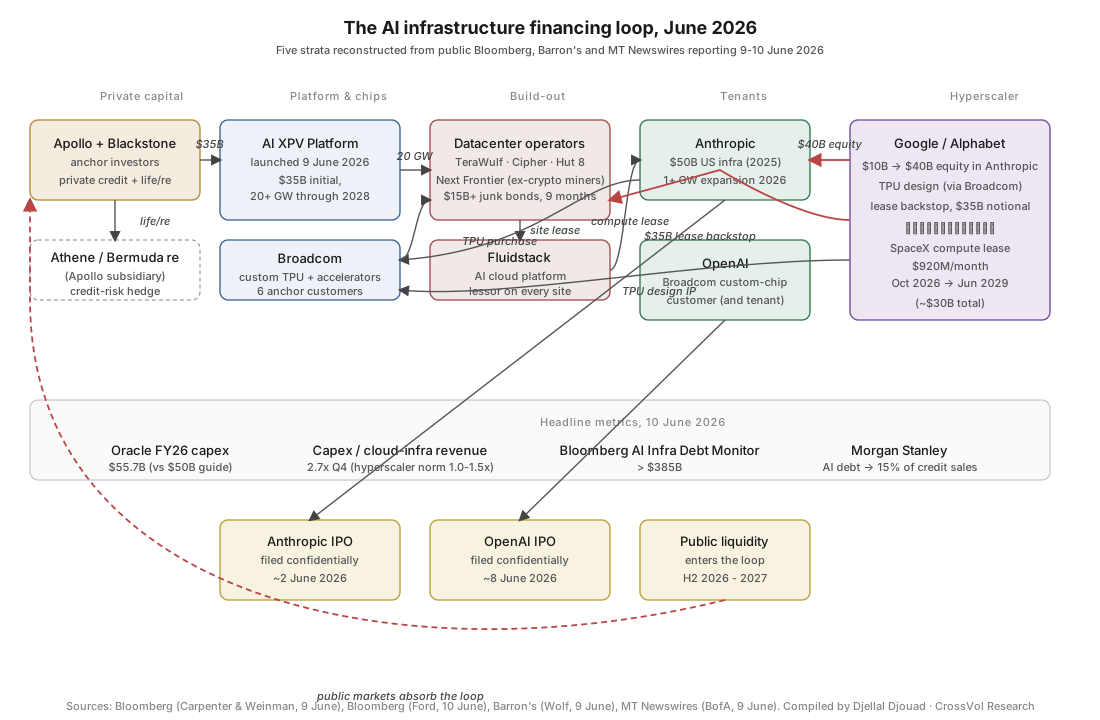
Five Bloomberg, Barron's and MT Newswires reports filed in the thirty hours of 9 to 10 June 2026 describe what looks, on inspection, like a single object. Read separately, each tells a partial story. Read together, they trace a closed graph in which equity, debt, chips, leases, backstops and reinsurance circulate among the same handful of names.
What follows is a strict reading of the public reporting. No proprietary data. No confidential interviews. Only what the tape gave us, in the order it gave it.
Stratum 1. Public equity
On 10 June at 22:47 GMT, Bloomberg reported Oracle's fiscal fourth quarter.1 Headline revenue rose 21 per cent to $19.2 billion. Cloud infrastructure revenue rose 93 per cent to $5.8 billion, slightly ahead of the 91 per cent consensus. Adjusted earnings beat: $2.11 per share against $1.97 expected. By the conventional Q4-day playbook, this should have been a clean print.
The share reaction was the opposite. Oracle declined roughly 4 per cent in extended trading, after closing the cash session at $201.26. The single line that moved the tape was capital expenditure: $15.9 billion in the quarter, $55.7 billion for the fiscal year, against management's own $50 billion guidance. Annualised, the Q4 capex run rate sits near $64 billion. Wall Street already pencils in $61.7 billion for fiscal 2027.
The ratio that matters is simple. Quarterly capex divided by cloud infrastructure revenue equals 2.7 times. A normalised hyperscaler ratio sits between one and one and a half. Oracle is spending $2.70 of property, plant and equipment for every $1 of cloud infrastructure revenue it currently books. To support the spread, the company raised $43 billion in debt and $5 billion in equity during the year just ended, and plans another $40 billion of issuance in fiscal 2027, including a $20 billion at-the-market programme.
A note from TD Cowen on the same day attributed the prior three-month equity rally to "better investor sentiment toward computing providers and OpenAI, Oracle's most important customer." The tape's after-hours move suggests that sentiment is finite.
Stratum 2. Sell-side modelling
Twenty-four hours before the print, on 9 June at 14:43 GMT, BofA Securities published a pre-earnings note that reiterated Buy on Oracle and raised the price objective from $200 to $240.2 The note modelled fiscal 2027 capex at $68.3 billion, a figure even more aggressive than the Street's $61.7 billion. BofA expected cloud PaaS and IaaS revenue to grow 94 per cent in the quarter, on the view that "more data center capacity comes online."
The drift between $200 and $240 in twenty-four hours, then a 4 per cent after-hours decline once the actual capex figure was disclosed, is itself a data point. The sell-side modelled the capex line as a leading indicator of future revenue. The market, given a fresh reading, priced it as a drag on profitability. Two readings of the same series, twenty-four hours apart, with a price gap of roughly 20 per cent.
Morgan Stanley, quoted in Bloomberg the day before, set the broader frame in a single number: AI-related debt issuance, in its view, will become 15 per cent of total credit sales.3 If that number proves correct, the credit market is on track to acquire a sectoral exposure comparable in scale to the energy sector circa 2014 or the residential mortgage sector circa 2006.
Stratum 3. Private credit
The next layer is invisible on a stock screen. Across the nine months preceding June 2026, Bloomberg counted more than $15 billion of bonds raised by a cluster of datacenter operators with one common feature: they are all former cryptocurrency miners.4 TeraWulf, building at its Lake Mariner campus near Buffalo and a second site in Abernathy, Texas. Cipher Digital, building near Colorado City, Texas. Hut 8, readying a site in St. Francisville, Louisiana. A Next Frontier and Fluidstack joint venture, building in Sullivan County, Indiana.
Each of the deals is in the sub-investment-grade range. Each of them carries a lease, on the operational side, from Fluidstack, the AI cloud platform that aggregates the capacity to deliver to tenants. John Yovanovic, co-head of leveraged finance at MetLife Investment Management, put the lending logic in plain language: "in the sub-investment-grade market, we're essentially financing the picks and shovels. All of the hard equipment. But they're pretty straightforward, and for most issuers, we're effectively taking the credit risk of the Mag Seven." The Mariner reference is to the structural protection wrapped around the bonds.
That structural protection is the so-called Google backstop. As part of the security package, Google agrees to repay bondholders if Fluidstack defaults or files for bankruptcy. The backstop does not activate until the data centers are operational and the Fluidstack lease begins. Until then, the credit-risk transfer to Google is contingent, off-balance-sheet from Google's perspective, and on-balance-sheet for the operators and their bondholders. In effect, the credit market is pricing a long Google option whose strike is the operational date of each campus.
The arrangement raises a question that derivatives traders are trained to ask: what is the implied volatility of operational dates in five concurrent multi-gigawatt data centers, and is that volatility being priced anywhere? The honest answer, as of June 2026, is no.
Stratum 4. Circular tech equity
Layer four is the one that gives the loop its name. On 9 June at 16:50 GMT, Barron's reported the launch of the AI XPV Platform.5 The platform is a joint structure between Broadcom, Apollo Global Management and Blackstone, designed to power more than 20 gigawatts of compute capacity through 2028. Apollo and Blackstone are anchor investors. The initial commitment is $35 billion, led by Apollo. The first customer named is Anthropic, for its previously announced 1-gigawatt expansion this year.
Hock Tan, Broadcom's chief executive, framed the launch as "a historic inflection point where the demand for AI compute is fundamentally reshaping the global economic landscape." The Barron's report adds that Broadcom's six anchor custom-chip customers include Alphabet and OpenAI.
Twelve hours later, Bloomberg published the deeper transactional detail.6 The $35 billion loan structure backstopped by Google equips Anthropic with computer chips at five datacenters. Broadcom designs and ships the chips. Anthropic leases the capacity. Google guarantees the lease payments. Broadcom is also one of Apollo's anchor partners in the platform that is financing those datacenters. Google is simultaneously a strategic investor in Anthropic. Earlier in 2026, Google committed up to $40 billion of equity to Anthropic, up from $10 billion announced two months prior.
To extend the loop one further turn, late in the prior week SpaceX disclosed that Google had agreed to pay it $920 million per month, from October 2026 through June 2029, for compute capacity. Over the contract, the gross commitment runs near $30 billion. Google buys chips from Broadcom, designs TPUs that Broadcom ships, equity-finances Anthropic, backstops the leases that Anthropic signs, finances Anthropic capacity through XPV, and rents compute from SpaceX. Each connection is, in isolation, ordinary commercial activity. The set of connections, drawn together, is not.
Joe Allen, head of securitised credit strategies at Mariner's Bright Meadow team, observed that "a year ago, some wondered if there could possibly be enough demand to support all this infrastructure spending. In fact, the amount of infrastructure available is still a limiting factor, and companies are going to great lengths to ensure access." Christina Minnis, global head of alternatives origination at Goldman Sachs, told the bank's Global Credit Forum that "yes, there is some concentration. But it's spreading into the economy in a way that I think is constructive." The Bloomberg Global AI Infrastructure Debt Monitor pegs the cumulative figure at more than $385 billion.
Stratum 5. Public liquidity in waiting
The last layer is the most recent. On Monday 8 June, OpenAI filed confidentially for an initial public offering. Approximately a week earlier, Anthropic had done the same. Both transactions, when they price, will deliver tens of billions of dollars of fresh public capital into a network already populated by Apollo, Blackstone, Broadcom, Google and a small set of former cryptocurrency miners. The public market is about to acquire direct exposure to the structure described above.
The Federal Trade Commission's January 2024 inquiry into AI partnerships, which examined precisely these kinds of arrangements, has not been closed.7 The partnership count under review has grown materially since then.
Three historical mirrors
None of the actors in the present graph are doing anything illegal. None of the contracts is unusual on its own. The interest is in the joined structure, and structure has precedents.
The closest one is late-1990s telecommunications equipment.8 Lucent Technologies offered vendor financing to competitive local exchange carriers that used the loan proceeds to purchase Lucent switches. Lucent recognised the revenue and held the receivable. When the customers failed, the receivables impaired and Lucent's equity lost approximately 99 per cent of its value over twenty-four months. The shape of the trade was: a single supplier financed a customer base it had created and depended on for revenue recognition.
The second mirror is Japanese keiretsu cross-shareholdings, especially in the late 1980s.9 Banks held equity in industrial companies that held equity in banks. Reported leverage looked acceptable on a single-company basis. The aggregate equity exposure, once netted, was both larger and more fragile than balance sheets suggested. The Nikkei lost roughly two-thirds of its value over the following decade and a half. The shape was: balance-sheet exposure understated by single-entity accounting.
The third mirror is the 2007 conduit and monoline structure.10 Structured investment vehicles purchased asset-backed securities. Monoline insurers wrapped those securities. Sponsor banks supported the SIVs through liquidity facilities that the banks themselves disclosed as off-balance-sheet. When asset values fell, the support facilities consolidated, the monolines failed and the system absorbed approximately $1.4 trillion of losses. The shape was: a contingent guarantee, treated as off-balance-sheet for accounting purposes, that became on-balance-sheet under stress.
The Google lease backstop, the Apollo-Athene reinsurance pathway and the Broadcom-XPV financing role each rhyme with one of these three precedents. The author makes no forecast about the joint structure. The author observes only that the structural rhyme is unmistakable, and that the relevant question is whether the joint exposure is being measured anywhere.
Closing observation
The 2.7 times capex-to-revenue ratio at Oracle is one reading. The $385 billion debt monitor figure from Bloomberg is another. The 15 per cent share of credit sales projected by Morgan Stanley is a third. None of these numbers, on its own, is a thesis. Taken together, with the structural connections drawn in the diagram above, they invite a question that derivatives desks routinely ask of complex exposures: where is the joint loss concentrated, and who is short the option that the loop continues?
That question is the subject of two recent works under the CrossVol Research imprint. The China AI Disruption Thesis dates the disruption pressure on the US side of the trade and traces the divergence between hyperscaler credit spreads and the underlying datacenter operator debt. Convergent Faults sets out the private-credit, reinsurance and grid-constraint mechanism through which a single shock can propagate across the system. The full reasoning, with the dated catalysts, is in those texts.
Djellal Djouad · CrossVol Research · 10 June 2026
Footnotes
- Brody Ford, "Oracle's Higher Data Center Spending Overshadows AI Growth," Bloomberg, 10 June 2026, 22:47 GMT.
- "Oracle's Core Business Strength Likely Sustained in Q4, BofA Securities Says," MT Newswires, 9 June 2026, 16:43 GMT.
- "Morgan Stanley Sees AI Debt Becoming 15% of Credit Sales," Bloomberg video segment, 9 June 2026.
- Scott Carpenter and Aaron Weinman, "Google's Backstops Underpin $35 Billion Chip Deal for Anthropic," Bloomberg, 9 June 2026, 20:26 GMT; and the related Bloomberg piece "Crypto Miner Evokes 'Barbarians at the Gate' With Huge Junk Deal."
- Nate Wolf, "Broadcom Teams Up With Apollo and Blackstone on AI Infrastructure Push," Barron's, 9 June 2026, 16:50 GMT.
- Carpenter and Weinman, op. cit.
- U.S. Federal Trade Commission, "FTC Launches Inquiry into Generative AI Investments and Partnerships," 25 January 2024.
- Lucent Technologies Inc., Annual Report on Form 10-K, fiscal year 2000, sections on vendor financing receivables.
- Bank of Japan, Tankan series; cross-shareholding ratio data, Nomura Securities historical reports, 1985-2003.
- Bank for International Settlements, Quarterly Review, "The credit losses of major banks and the financial system," March and December 2008; IMF Global Financial Stability Report, April 2008, on conduit and monoline exposures.
- Bloomberg Global AI Infrastructure Debt Monitor, accessed 10 June 2026, total exceeding $385 billion.
- Christina Minnis, public remarks, Bloomberg Global Credit Forum, June 2026.
- John Yovanovic, public remarks attributed in Carpenter and Weinman, op. cit.
- Joe Allen, public remarks attributed in Carpenter and Weinman, op. cit.
- Hock Tan, Broadcom press release, 9 June 2026, accompanying the AI XPV Platform announcement.
- Anthropic, "$50 Billion U.S. Compute Infrastructure Investment," company statement, November 2025.
- Oracle Corporation, Q4 fiscal 2026 earnings release, 10 June 2026.
- Derrick Wood, TD Cowen, equity research note on Oracle Corporation, 10 June 2026.